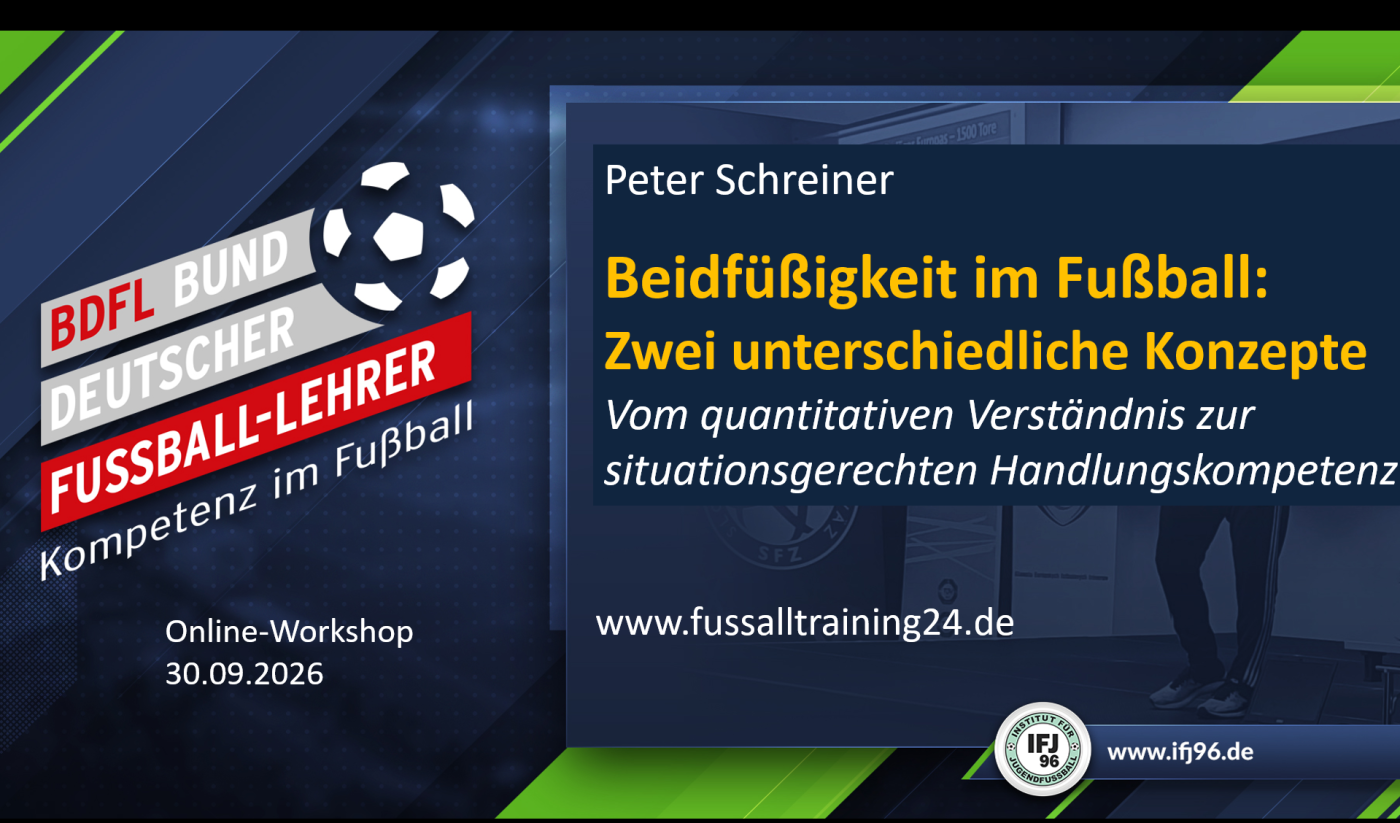
On 30 September 2026, Peter Schreiner led an online workshop of the Bund Deutscher Fußball-Lehrer (BDFL) for the renewal of the A and Pro licences. The focus was on the topic “Two-footedness in football: two different concepts – from a quantitative understanding to situation-appropriate competence in action.”
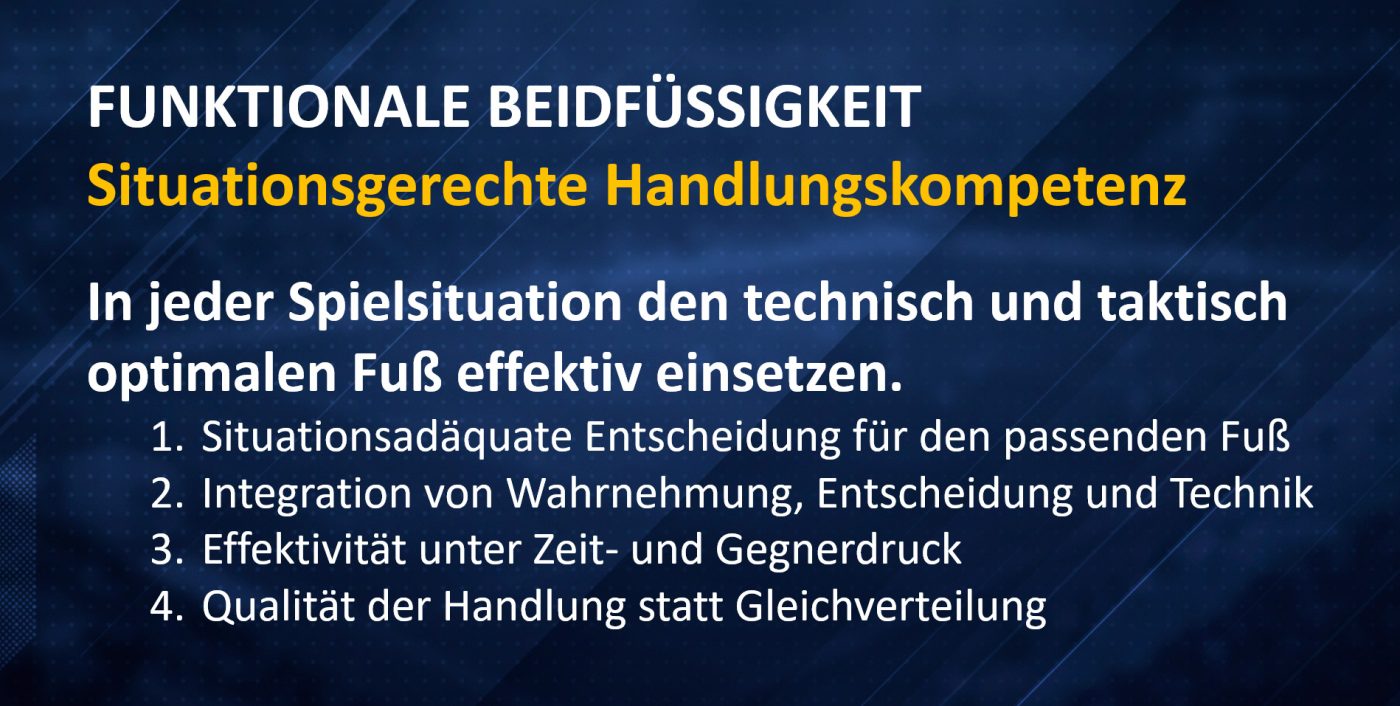
It was not only about how often players use their weaker foot. Instead, Peter Schreiner put the idea of functional two-footedness at the centre: in every match situation, the player should be able to use the technically and tactically optimal foot effectively.
Functional two-footedness: more than just using both feet
A central point of the workshop was the distinction between a quantitative understanding of two-footedness and situation-appropriate competence in action.
Accordingly, functional two-footedness does not mean using both feet as equally often as possible. What matters instead is the quality of the action and the player’s ability to find the right solution in a specific match situation.
Several factors come into play here:
- a situation-appropriate decision for the right foot
- integration of perception, decision and technique
- effective action under time pressure and pressure from opponents
- quality of action rather than a mere equal distribution
In football in particular, situations frequently arise under heavy time pressure and pressure from opponents. The player has to perceive, decide and then act with clean technique. The choice of foot is one part of this entire chain of action.
Perceiving, deciding and acting technically
Another focus was therefore on the link between perception, decision and technique.
Two-footedness is not viewed in isolation. Rather, in match situations it should help players to have different options for action and to choose the solution that suits the situation.
This can be seen, for example, in passing or finishing: the supposedly stronger foot is not automatically the best solution. What matters, among other things, are the player’s position, the match situation, the pressure from opponents and the time available.
Practical examples and match scenes
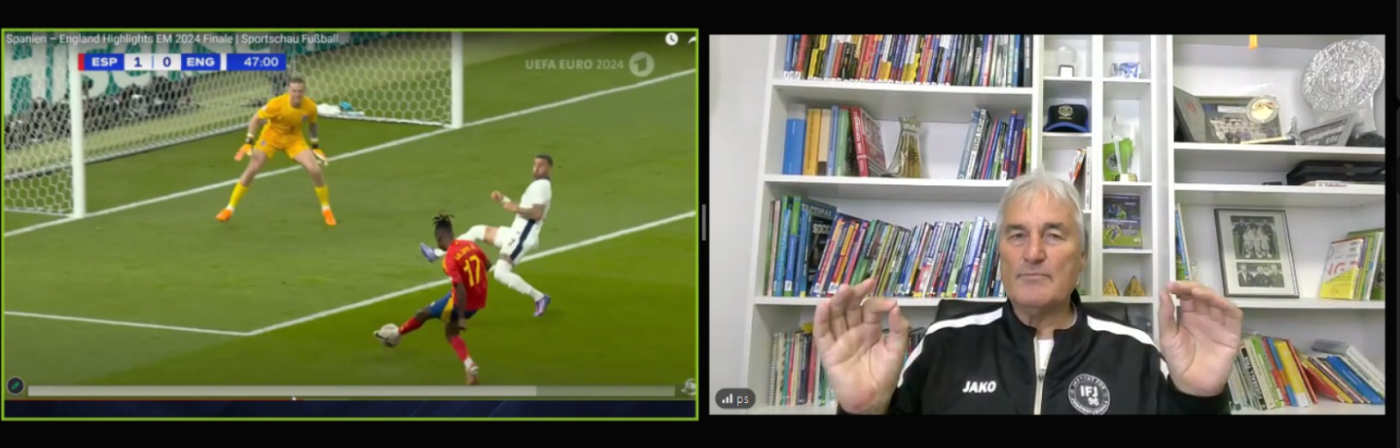
To illustrate the different concepts, Peter Schreiner worked with concrete match scenes and practical examples in the workshop.
One of the scenes shown, for example, dealt with a finishing situation from top-level international football. Match situations like this make it clear how important a situation-appropriate choice of foot can be for a successful technical action.
Training examples were also used to make the transfer to day-to-day work on the pitch.
Quality of action rather than equal distribution
One important message of the workshop was: the real goal is not using both feet as evenly as possible, but the quality of the action.
A player should certainly develop their less preferred foot in a targeted way. At the same time, however, development must always remain connected to the demands of the game.
This shifts the focus from the mere question
“How often does the player use the left foot and how often the right?”
towards:
“Which foot enables the best solution in this situation?”
It was precisely this change of perspective that was at the heart of the workshop.
Positive feedback from participants
The practical orientation of the workshop was well received by the participants.
Markus, Football Academy | Head of Culture & Football Development, thanked Peter Schreiner for the successful presentation and workshop and emphasised that he was once again able to take away new ideas.
Vural also stressed how practical the course was and the many ideas for practical work.
Marc-Christopher, DFB-Stützpunkt Bad Soden, particularly highlighted the practical examples in the form of videos and training sessions, which were helpful for his work.
From two-footedness to competence in action
The BDFL workshop made it clear that two-footedness in modern football can be more than simply training a weaker foot.
The focus is on the player’s ability to combine perception, decision and technical execution and to find the right solution under time pressure and pressure from opponents.
Two-footedness thus becomes part of a broader situation-appropriate competence in action – and a topic that can be linked directly to practical training work.
In his workshop, Peter Schreiner showed what this change of perspective – from a quantitative view of two-footedness to its functional and situation-appropriate application in football – can look like.