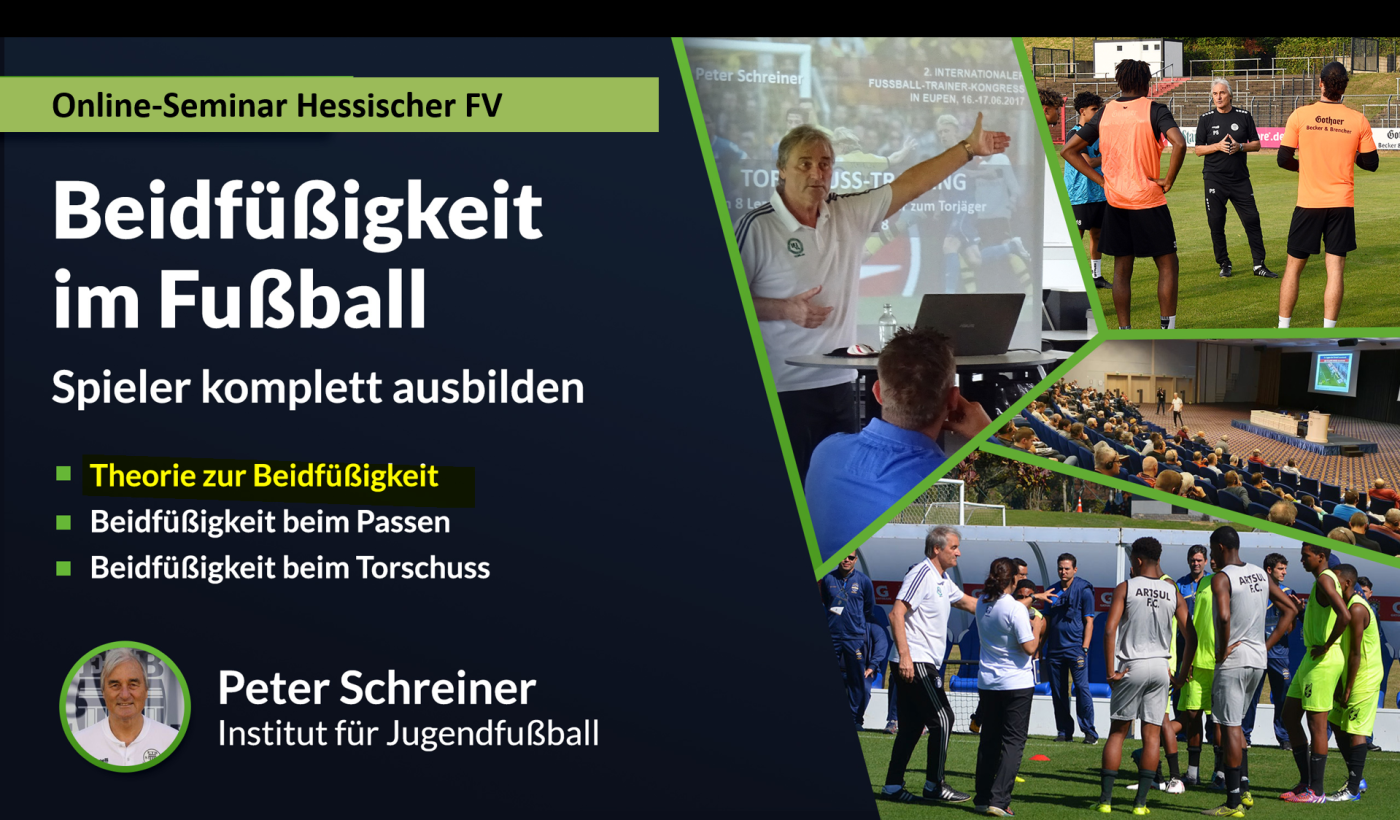
On 15 September 2026, the Hessischer Fußball-Verband held a four-hour online workshop with Peter Schreiner. Around 40 participants took part in the event and gained numerous insights into finishing development, two-footedness and the practical design of passing and finishing training.
The workshop had a very practical structure. Alongside the theoretical foundations, numerous match scenes and training videos featuring different teams were shown and concrete exercises were presented.
These topics were the focus
The online workshop covered the following topics:
- Theoretical introduction to Peter Schreiner’s Finishing Matrix
- Two-footedness in passing and finishing
- Practical examples of two-footedness in the warm-up and passing exercises in groups of 2, 3 and 4
- Practical examples of finishing training with two-footedness
Peter Schreiner’s Finishing Matrix
At the start, Peter Schreiner presented his Finishing Matrix. The term and the concept behind it stem from his many years of work on systematic finishing development.
The Finishing Matrix serves to look at the different areas of finishing training in a structured way and to connect them with one another. It is not only about the shot itself. Aspects such as the preparation of the finish, the choice of foot, precision and different match situations also play a role.
Peter Schreiner has covered the content surrounding the Finishing Matrix in detail in several publications. These include „Torschuss-Ausbildung – Lernstufen 1–4“ ("Finishing development – learning stages 1–4"), „Torschuss-Ausbildung – Lernstufen 5–8“ ("Finishing development – learning stages 5–8"), „Präzision beim Torschuss“ ("Precision in finishing"), „1 v 1 gegen den Torwart“ ("1 v 1 against the goalkeeper") and „Torschuss-Training in Spielformen“ ("Finishing training in game forms").
Two-footedness in passing and finishing
The workshop then turned to the question of how players can be introduced in a targeted way to using both feet.
In passing and finishing in particular, two-footedness can be integrated into many existing exercises. Even small changes can ensure that the less preferred foot is used regularly.
The workshop showed concrete options for the warm-up as well as various passing exercises in groups of 2, 3 and 4. Peter Schreiner has also covered this fascinating topic in detail in his book „Beidfüßigkeit im Fußball“ ("Two-footedness in football").
Example exercise: two-footedness – figure-of-eight run (short version)
Example exercise: two-footedness – one player runs (short version)
Practical finishing training
Another focus was on various forms of finishing training. Among other things, exercises were presented in which two-footedness and precision are specifically trained.
The 1 v 1 against the goalkeeper was also addressed as a concrete match situation. Here it is not only about the technical execution of the shot, but also about perceiving a situation, making a decision and executing the finish accordingly.
Thanks to the training videos and match scenes shown, the participants were able to link the content directly to real situations from football.
Lots of positive feedback from participants
The feedback after the workshop showed that the high proportion of practical content went down well. Participants particularly highlighted the many concrete examples and the opportunity to use the exercises presented directly in their own coaching.
One participant described the presentation as very practical and emphasised that the examples had shown the small and large adjustments coaches can make to involve the less preferred foot more in training.
The combination of theory and real match scenes was also well received. The practical examples in particular were felt to be helpful because they allow a direct transfer to one’s own team.
Another participant saw the passing and finishing exercises presented as offering interesting possibilities for developing players across different age groups – from Bambini to U19.
“A very practical presentation, illustrated with lots of great examples. All in all, few questions were left open and I feel extremely well informed. The course provided great insights into the small and large adjustments you can make to get players to enjoy using their unloved foot too. Partly using familiar exercises, with small adaptations.”
Axel
“Thank you for the interesting and well-structured course. It was easy to follow the content, and there were enough practical examples that I will be happy to use with my team over the coming weeks.”
Andreas
“Many thanks from my side for this excellent workshop and the ideas. It is important to have people like you for young people!”
Alexander Hübner – TSV Weiher 1904 e. V.
“Hello Peter, many thanks for the very interesting presentation. What I find important are the examples for applying it in training and not just the theory. It is also more exciting to see clips from real scenes.
Orkun
“First of all, many thanks – there were great ideas and approaches that can be implemented progressively from Bambini to U19, even at grassroots level. I am also convinced by the approach of differential training methods. The passing exercises and the basic finishing exercises in particular are practically crying out for additional cognitive, visual or coordinative stimuli.”
Philipp Hesse – SKG Bickenbach
Peter Schreiner: finishing development with a system and a practical focus
The online workshop with the Hessischer Fußball-Verband thus combined the theoretical presentation of the Finishing Matrix developed by Peter Schreiner with concrete exercises and match situations.
From two-footedness and passing to precision and finishing in 1 v 1 situations, Peter Schreiner showed various ways of making finishing training varied and practical.
The around 40 participants received numerous ideas that can be transferred directly to their own coaching.